
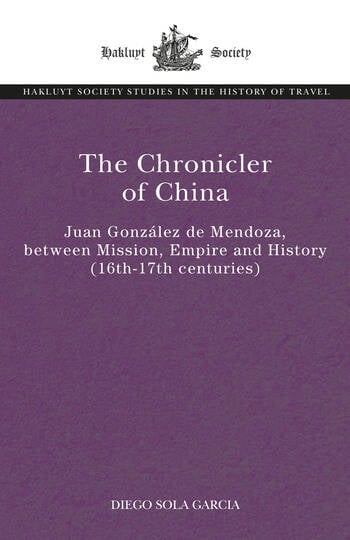
Aquest 18 de març l’editorial anglo-estatunidenca Routledge publica l’edició en anglès de El cronista de China. Juan González de Mendoza, entre la misión, el imperio y la historia (llibre publicat el 2018 per Edicions UB en coedició amb l’Institut Confuci). El llibre original ha estat revisat, traduït i ampliat (amb especial atenció a l’impacte que el llibre de 1585 Historia del gran reino de la China del frare agustí Juan González de Mendoza va tenir al món anglosaxó a finals del segle XVI). El títol, precedit pel pròleg de Joan-Pau Rubiés “Juan González de Mendoza and the European discovery of China”, apareix dins la col·lecció Hakluyt Society Studies in the History of Travel, dedicada a la història de la literatura de viatges en època moderna i està basat en bona part en la meva tesi doctoral, defensada a la Universitat de Barcelona l’any 2015.
Aquí us deixo la nota del llibre:
This monograph provides an analysis and contextualization of an extraordinarily successful book, the History of the Great Kingdom of China (Rome 1585), by the Spanish Augustinian friar Juan González de Mendoza (1545–1618). Within a few years, this book had reached 30 editions and had been translated into several languages, including English. Mendoza’s chronicle shaped the late Renaissance interpretation of China across Europe. It had its origin in an embassy to emperor Wanli of China sent by Philip II, ruler of the Spanish and Portuguese overseas empires in America and Asia. Reconstructing the biography of González de Mendoza with new sources, this volume offers a systematic study of his account of late Ming China, analyzing its reception and influence both in Spain and elsewhere in Europe.
The Chronicler of China is divided into five chapters, covering the Portuguese and Castilian sources that recorded the earliest contacts with China in the sixteenth century, the figure of Mendoza as an ethnographical and political writer, the building of his chronicle on China, the dialogue with his sources and, finally, the footprint of Mendoza’s book in the European Republic of Letters.
This book, the most complete study on the Augustinian Mendoza and his historical and ethnographical work to date, contributes to a wider understanding of the Iberian contribution to sixteenth-century travel writing and the Western knowledge of China. It will appeal to scholars and students alike interested in the early modern interpretation of China in Europe.
Diego Sola is Senior Lecturer of Early Modern History at the University of Barcelona, where he obtained his PhD with the Extraordinary Doctoral Prize of the Faculty of History in 2015. His academic research is mainly focused on the Iberian religious in China and the Philippines as cultural creators and mediators during the Early Modern Era (sixteenth to seventeenth centuries), as well as the process of building of a specific image of Asia in the monarchies of Spain and Portugal through the textual productions of the missionaries.
 Historiant, historiant...